

Mourning Professor Yang Chen-Ning
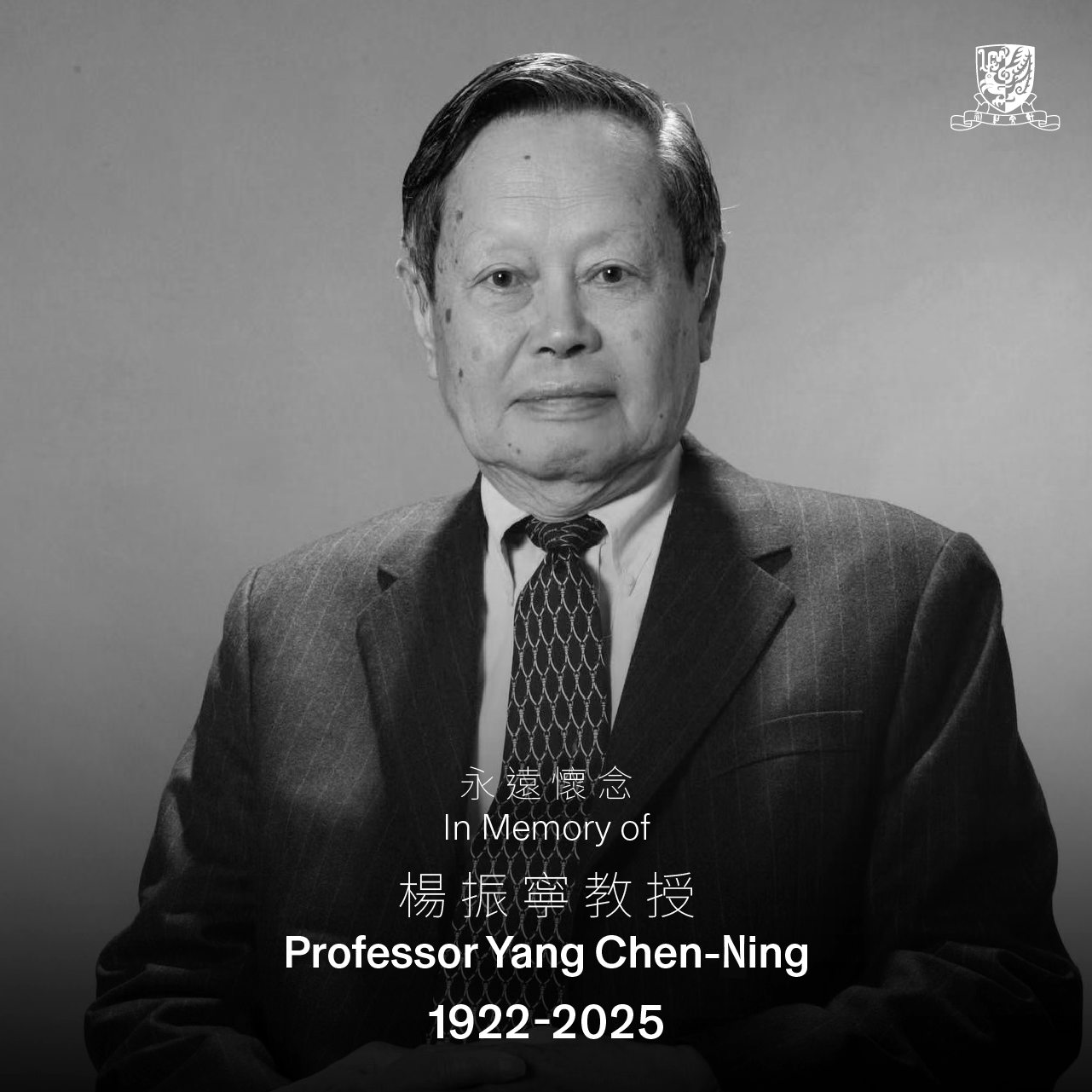
Professor Yang Chen-Ning, the first Chinese Nobel Laureate, Distinguished Professor-at-Large and Director of the Institute of Theoretical Physics at The Chinese University of Hong Kong (CUHK), passed away on 18 October 2025, at the age of 103.
Professor Yang was widely recognised as a preeminent scientist. In 1957, he won the Nobel Prize in Physics with his co-researcher, Professor T.D. Lee, for their theory of parity non-conservation for the weak interactions, marking the first time that Chinese scholars had received this honour. In 1954, with Robert Mills, Professor Yang also formulated the theory of non-Abelian gauge fields (known as Yang-Mills theory), a groundbreaking work that laid the theoretical foundation for modern particle physics. His research profoundly shaped the development of physics from the mid-20th century onwards, particularly in the fields of particle and statistical physics. From the 1970s, Professor Yang visited China frequently, working tirelessly to advance Chinese physics and promote Sino-US relations. In 2003, he settled in China, sharing his time between Beijing and Hong Kong.
Professor Yang’s connection with CUHK began in the 1960s. After giving a public lecture in 1964, he visited and lectured at the University frequently. Professor Yang had consistently supported the Department of Physics, particularly in its academic and research development. Professor Yang taught the graduate course “Special Topics in Theoretical Physics” in 1983. In 2006, at the age of 84, he co-taught the undergraduate course “Main Themes of Theoretical Physics in the 20th Century” with Professor Kenneth Young. Professor Yang continued to teach the course through the 2008-09 academic year. Professor Yang also frequently joined meetings organized by the Department of Physics, to discuss and exchange ideas with physics students and faculty members. Besides actively participating in academic activities, he also supported the establishment of research institutes within the Department and promoted the establishment of scholarships, benefiting both researchers and students.
Express your condolences here:


