

The University's stance on the use of GenAI
The University has released a guideline regarding using Generative AI in Education: "Use of Artificial Intelligence Tools in Teaching, Learning and Assessments - A Guide for Students", stating clearly how the University may integrate AI tools in its teaching and learning while upholding academic honesty, integrity and quality.
As a general principle, unless specifically permitted, students are expected to complete all coursework, formative and summative assessments independently without the use of AI tools or other forms of unauthorized assistance. Otherwise, the case should be handled in accordance with the University’s Procedures for Handling Cases of Academic Dishonesty if a student is found to have used AI tools in the assignments/assessments.
Is it safe to use ChatGPT?
The following flowchart illustrates the circumstances in which ChatGPT may be safe to use:

ChatGPT and Artificial Intelligence in Higher Education Quick Start Guide (UNESCO, 2023)
How to cite AI-generated content?
Any ideas and content that did not come from yourself must be cited in your work, including those content generated by AI tools. It is also important to include the prompts you used since the “chat”(i.e. your prompts and the responses from the AI tools) is not retrievable by other readers. The prompts can be stated in your content or listed by a copy of the text as an appendix.
Below is an example showing the format of in-text citations and references in APA citation style.
In-text citation format:

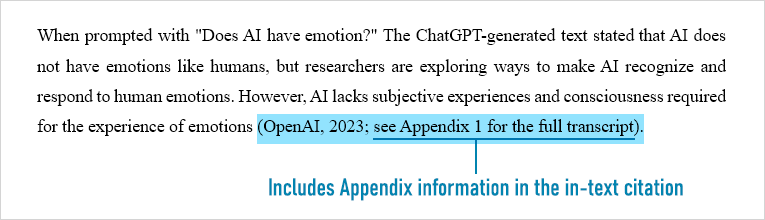
You can also supplement your writing with an Appendix that included the entire "chat" and add a description in the in-text citation.
Reference format:

For more information related to citing AI-generated content in different citation styles, please see below:
Featured Reading
This library guide introduces the basic concepts and library resources to help you to use information responsibly for your assignment and academic research.


